How We Built a Kayak Expedition From the Inside Out
Most adventure trips in Komodo are designed by people who’ve visited. This one was built by people who stayed.
The Komodo Archipelago sits between two oceans. To the south, the Indian Ocean. To the north, the Pacific. They meet in a tangle of narrow straits between Komodo, Rinca, Padar, and Flores – and because those oceans differ in temperature, salinity, and sea level, they’re constantly trying to fill each other through passages that are shallow, tight, and unforgiving. The result is some of the strongest tidal currents in Southeast Asia. Three to six knots through the narrows on a normal day. Whirlpools. Standing waves. Streaks of moving water visible from the surface that look, from a kayak, exactly like what they are: rivers running through the sea.
This is where we built a multi-day kayaking program. Not because it was easy. Because our team lives here, and they knew what it was worth.
Why Community First Wasn’t a Slogan
The kayaking program didn’t start with a product brief. It started with a question that our local Flores team kept coming back to: what would it look like to build something that moved slower, reached deeper, and kept the economic benefit inside the communities that actually share this landscape with the dragons and the mantas?
What this means in practice is that this isn’t a program we designed from the outside and then handed to local staff to run. The routes, the tidal timing, the daily decision-making – that all comes from people who’ve been on this water for years, not people who flew in with a clipboard and good intentions. And honestly, I think that distinction matters more than most tourism marketing lets on.
The guides who lead these expeditions are certified, locally trained, and built their experience through seasons of actual on-water time in Komodo’s conditions. The tidal briefings they deliver each morning, timing departures to use the current rather than fight it, come from years of accumulating exactly that kind of knowlege. It cannot be imported. It has to be earned on the water, in this specific place, repeatedly.
That’s the model. And it works because the community was part of building the trip, not just part of staffing it.
What the Archipelago Actually Feels Like From a Kayak
Komodo from a boat is spectacular. Komodo from a kayak is something else entirely.
You move at the pace of the water. Early mornings, when the surface is flat and the light comes low across the islands, schools of garfish scatter off the bow. Channels open between headlands that a liveaboard simply can’t enter. Beaches appear – black sand, white sand, the famous pink of crushed coral at Pink Beach – and you land on them quietly, without an engine, without a crowd. On longer expeditions, you reach islands that don’t feature in standard itineraries because nobody running a standard itinerary has taken the time to get there.
The dragons, when you approach Rinca by paddle rather than by tender, feel genuinely wild in a way that a guided walking group experience doesn’t quite replicate. Three meters of prehistoric animal moving through the shoreline scrub above the tideline, tongue tasting the air, utterly indifferent to your presence. No fence. No performance. Just an animal in its habitat and you in yours, briefly overlapping.
Underwater, the same currents that make the paddling technical are the reason everything is so alive. They pull cold, nutrient-rich water up from depth constantly, feeding the base of the food chain and keeping the water clean and oxygen-rich. Manta rays aggregate at cleaning stations in the north of the park. Sea turtles move through Siaba Besar in numbers that earned it the name Turtle City. Coral gardens that would be headline destinations anywhere else in the world are simply Tuesday afternoon here, because Tuesday afternoon in Komodo is always going to be exceptional.
How the Expedition Is Structured
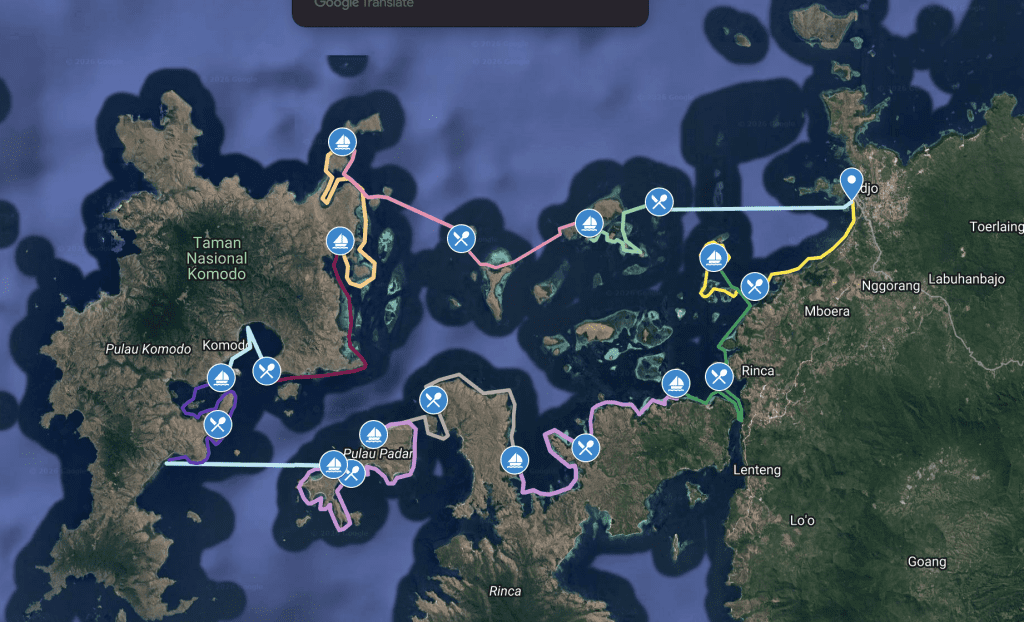
Every expedition is planned in detail before guests arrive – routes, activities, logistics, all discussed together so the journey reflects what the group actually wants. But the daily reality is always guided by conditions: weather, sea state, tidal windows, how the group is feeling on day six of fourteen. The structure exists to support the flexibility, not constrain it.
A five-day program gives meaningful time inside the national park – Kelor and Pungu islands, Rinca for dragons, Padar for the summit hike that earns its famous view across black, white, and pink sand bays, the underwater highlights around Komodo itself. Fourteen days opens the route properly: north Rinca’s secluded bays, the quieter corners of the archipelago that most visitors’ll never reach, the kind of pacing that lets you stay longer in one place when the place demands it.
Twenty-one days is for people who understand that more time in Indonesia is never the wrong decision.
The boat – a traditional Indonesian phinisi, extensively refitted and running as a comfortable floating base – travels with the kayaks throughout. On harder days or bigger crossings, guests can rest on board and rejoin the group at the next stop. There’s no shame in this. The sea here is not decorative; it has moods and intentions, and the program is designed to work with that reality honestly rather than pretend it away.
What the Guests Say
The feedback from people who’ve done this is consistent in a way that matters. Not just “great trip” – but specific. Flawless logistics and a lovely Indonesian team, always attentive. Well-balanced days between paddling, snorkeling, and local meals. That’s a guest review, but it’s also a description of exactly what the local team built: something that works because the people running it care about it working, because this is their home and their livelihood and their coastline.
A complete break from daily life at the end of the world – warm, beautiful, and genuinely exotic. That’s the other thing Komodo delivers when you approach it right. The archipelago doesn’t feel like a managed experience. It feels like a place that exists on its own terms, and that you’ve been allowed into briefly, with good guides who know how to move through it with respect.
The Bigger Point
We run this expedition every year now. And look – it’s part of our program not just because it sells well, though it does, but because it’s an example of how we think adventure tourism should actually work, when you get the incentive structure right and trust the people who know the place…
The routes were developed by people with deep local knowledge. The benefit stays in Flores. The experience is better for it, because local knowledge in a place like Komodo isn’t a nice-to-have. It’s the difference between reading the tidal window correctly at six in the morning and spending an exhausting hour paddling against a current that a more experienced guide would never have put you in.
Indonesia is home. These are the islands our team grew up alongside, fished alongside, built lives alongside. When we take guests into the Komodo Archipelago, we’re not showing them a product. We’re showing them where we live.
Wicked Adventures designs and operates kayaking, diving, birdwatching, trekking, and climbing expeditions across Eastern Indonesia. All local team. All local wisdom. Get in touch to find out what we’re running.