How we design low‑leakage, community‑benefitting hiking & yoga trips in Bali – and why it makes business sense.
Tourism to Indonesia is booming again. Bali alone receives more than half of the country’s international arrivals, and the global conversation is full of big numbers: record visitors, record flights, record spend. But behind the headlines there is a harder question that rarely makes the marketing copy:
Where does the money actually go – and what does it feel like to travel here?
At Wicked Adventures, a DMC and tour operator based in Indonesia, we have spent the last few years rebuilding our hiking and yoga portfolio around a simple idea:
Design trips where guests travel slowly, communities genuinely benefit, and value is created through experience, not volume.
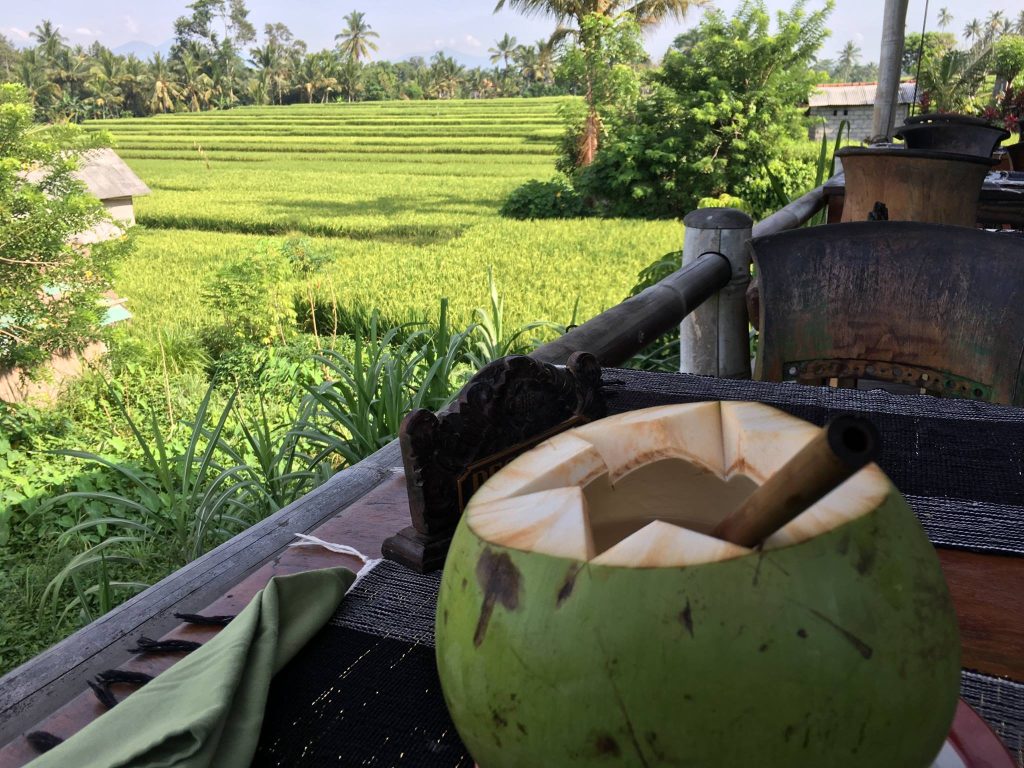
This article shares how that thinking shaped a two‑week hiking & yoga journey in Bali, and why that approach matters for travellers, communities, and our business.
What is economic leakage in tourism?
In tourism research, economic leakage is the share of visitor spend that leaves the destination economy instead of circulating through local people and businesses. It happens whenever:
- Hotels and operators are foreign‑owned and send profits offshore.
- Food, drink, building materials and supplies are imported rather than bought locally.
- Bookings, payments and marketing are controlled from outside the destination.
Global analyses from institutions like UNWTO and the World Bank have shown the same pattern for decades:
- Developed destinations often see 10–30% leakage.
- Developing or highly intermediated destinations can lose 40–80% of tourism revenue before it reaches local communities.
In other words: high arrival numbers do not guarantee local prosperity. A 2025 briefing on Thailand, for example, notes that rapid, unregulated growth has brought environmental damage, overburdened infrastructure, and significant profit leakage to foreign investors and large hotel chains.
Recent work on the “digital leak” adds a new layer: when bookings, payments and review systems are controlled by offshore platforms, local businesses lose pricing power and value capture, even if visitor numbers look healthy.
For small tour operators and DMCs, this isn’t an abstract statistic. It’s a design problem.
Slow tourism and community‑based travel in Bali
At the same time, global and European reports highlight a steady rise in slow, local and community‑based tourism. Travellers increasingly want:
- experiences rooted in local culture and nature,
- smaller‑scale, authentic encounters,
- more time in fewer places,
- and trips that feel meaningful, not rushed.
In Bali specifically, community‑based tourism (CBT) has been part of the island’s development strategy for decades. The Bali Master Plan and related work emphasise:
- cultural tourism over mass tourism,
- local participation and benefit,
- and “slow tourism” as a way to support place attachment, self‑governance and more equitable development.
Academic writing on CBT in Bali frames it as a decolonial alternative to extractive models: centring residents’ voices, allowing communities to co‑define problems and solutions, and enabling tourists to “live like a local” without imposing undue costs on the environment or culture.
This is the context in which we have been redesigning our own trips.
Our design goal: low leakage, high local benefit
For our Bali hiking & yoga product, we set ourselves a simple internal target:
Design an 11–12 day trip where, once flights, fuel and unavoidable admin are stripped out, roughly 95% of on‑the‑ground spend benefits communities within ~50 km of where guests sleep.
That is not a perfect number; it is a realistic one. To get there, we focused on four levers that any DMC or tour operator can use:
- Where guests sleep
- How they move
- Where they eat and spend time
- Who runs the experiences
Instead of starting with a list of “highlights”, we started with a map of relationships.
Communities, not commodities: how we choose partners
There is a mystique around economic leakage, as if you need a full input–output model to understand it. In practice, for small‑to‑medium operators, the first step is simple: ask questions.
When we meet potential partners in Bali, we ask:
- Who owns this guesthouse/hotel/activity company?
- Where are the owners based?
- Where do most of your staff come from?
In homestays and small guesthouses, the answer is usually obvious. You are sitting in a family compound, the house is on their land, and you can see the ricefield a relative works. Payments for rooms or meals are clearly income for that household and immediate community.
As you scale into 3‑ and 4‑star properties, things get more complex:
- A local landowner.
- A hotel or investment company, often based in Denpasar or Jakarta.
- A separate management company running operations.
Each layer can extract value. Some of that may still be within Indonesia; some may be offshore.
We still ask. Gently. It’s a conversation, not an interrogation. In locally rooted operations, there is usually pride in answering “we’re from here; our staff are from these villages.” As properties get bigger and more polished, you can often feel the distance from the place grow.
This matters because “local” is not a simple word in Indonesia.
- From a Western marketing perspective, “local” might mean within a few kilometres, within 50 km, or simply “from the same country”.
- On an island like Bali, with a strong internal migration and cultural diversity, that’s a blunt instrument.
For our purposes, we care most about how close the ownership and staff are to the landscapes and communities our guests actually walk through.
Food and the supply chain rabbit hole
Bali has a rich agricultural backbone: rice, vegetables, fruit, coffee, spices. In theory, we could track every tomato and egg through the supply chain. In practice, that quickly becomes unworkable.
A few realities:
- Asking “Is this organic?” in a local market often earns a puzzled look. Provenance is not usually framed in those terms.
- Most small warungs and restaurants source from a mix of wholesale markets and local suppliers; tracing individual items is difficult.
So we use simple heuristics:
- We look at menus. If a restaurant leans heavily on imported steak, salmon, pork chops and cheeses, we know a significant share of each bill is leaving the local agricultural system.
- We favour places whose menus are clearly built around regional staples: rice, vegetables, tempe and tofu, seasonal fish, fruit.
On our Bali hiking & yoga itinerary, that translates to:
- In Ubud and Sanur: independent warungs and cafés within walking distance of where guests sleep, chosen for local ownership and locally oriented menus.
- In the mountains: an ecolodge with a garden‑to‑table kitchen supported by permaculture plots and neighbouring farms.
We do not claim every ingredient is from the next valley. We do aim to direct guest spend toward food systems that still have strong local roots.
Slow tourism as an operating system, not a vibe
“Slow travel” has become a buzzword. Reports from Europe and beyond describe it as staying longer in fewer places, moving at human speed, seeking depth over breadth. For us, slow is not a mood board; it is a series of very concrete design decisions.
On the Bali hiking & yoga itinerary, that meant:
1. Fewer bases, longer stays
We opted for two main bases plus a coastal finish:
- Ubud rice‑field base (5 nights).
- Forest/valley base (Batukaru ecolodge or Sidemen area, 4 nights).
- Sanur coast (1 night).
We deliberately avoided a classic “Bali highlights loop” with 5–6 different sleeping locations and one‑night stops. Guests settle in; they learn the walk from their room to the shala, get to know the homestay family or hotel staff, discover their favourite warung, recognise the same dog on the lane.
Research on slow travel and walking holidays suggests that this kind of dwell time increases perceived authenticity, emotional connection and satisfaction.
2. Walking first, vehicles second
Vehicles are used only for:
- airport → base 1 → base 2 → Sanur → airport,
- a few specific outings (for example, Sidemen valley or rafting).
Once guests are in each base, the default is to walk:
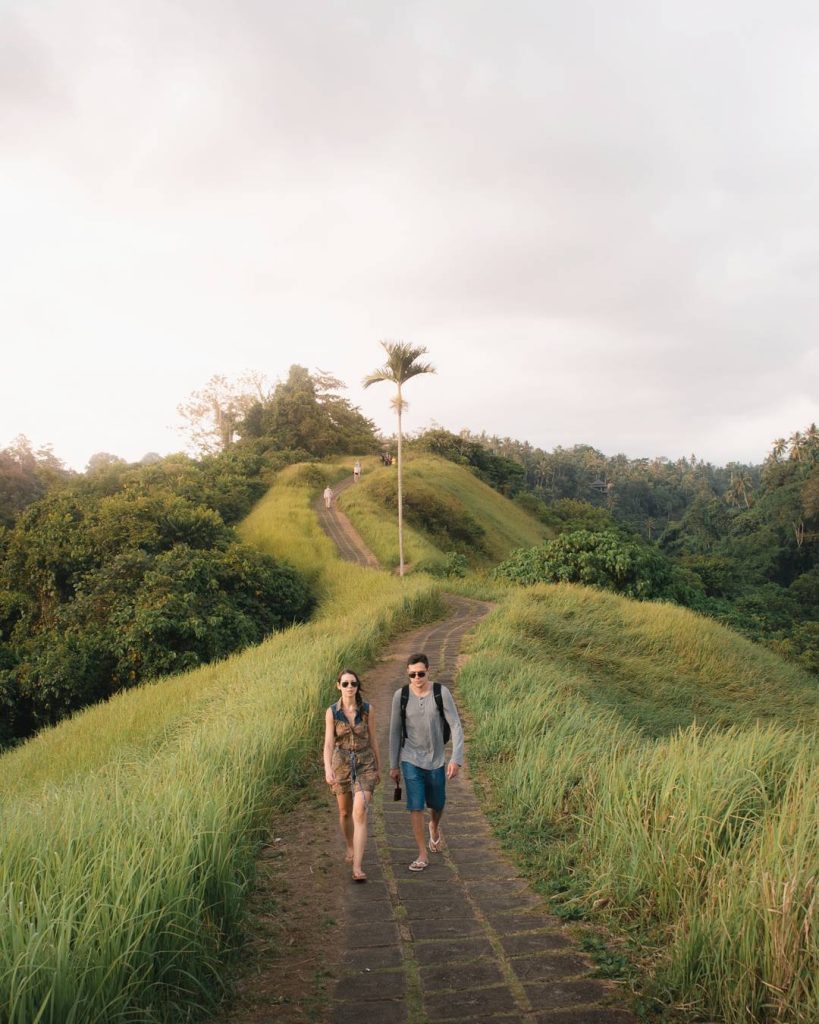
- In Ubud: Campuhan Ridge, subak paths, Monkey Forest, market, palace, workshops.
- In the mountains: forest trails, rice terraces, village lanes, river pools.
- In Sanur: sunrise promenade walks and markets.
Reports on slow and sustainable tourism note that walking and cycling enhance immersion, support local businesses and reduce environmental impact. For guests, this also changes how the trip feels: less time in traffic, more serendipitous encounters, a better embodied sense of distance and terrain.
3. Highlights woven into transit days
Bali has a long list of bucket‑list stops. Rather than trying to “fit everything in”, we integrated a few key places into transit days, where they made narrative and logistical sense.
For example:
- Visiting iconic rice terraces on the way between bases, by walking a loop rather than adding an extra long car day.
- Using transfers to connect water stories: from subak channels near Ubud to broader irrigation systems in other valleys.
This approach reduces carbon and bus time, while still allowing guests to see a handful of the places they have heard about.
4. Designing slack, not stuffing the schedule
A common reflex in tour design is to “add value” by filling every gap with another activity. Our internal guest feedback told us the opposite.
What people remember most often are:
- the conversations at the homestay or ecolodge,
- the second visit to the same café,
- the hour they sat reading while the sounds of the village carried on around them.
So we intentionally leave light afternoons and free mornings after busier walks. After a hectic day in Ubud, the right choice is often not another excursion but time to sit by the pool, wander back into town at one’s own pace, or just watch life around the homestay.
Post‑pandemic trends highlight increased demand for rest, mental wellness and “soft travel” experiences. Building slack into the itinerary is one way we respond.
Communication and guest expectations
Design alone is not enough. How we talk about these trips shapes who books them and how they behave.
We are explicit that:
- These are slow, locally rooted trips, not all‑inclusive highlight reels.
- We intentionally exclude some famous sights because the on‑site experience is poor, extremely crowded, or misaligned with our values.
- We do not promise 100% local benefit; we openly acknowledge unavoidable leakage (fuel, flights, some administrative overheads).
Instead, we frame value in terms of:
- the quality of time guests spend in a few places,
- the relationships they form (with hosts, guides, each other),
- the sense of belonging and empathy we hope they leave with.
We also encourage guests to:
- use pre‑ and post‑trip days for anything else they want to tick off the list,
- see our itinerary as one way of being in Bali, not as a definitive checklist.
This communication acts as a filter. Travellers who want a standard high‑throughput, low‑touch bucket‑list trip can easily find one through large operators or apps. The people who come to us are already partly aligned with what we’re doing.
Why this makes business sense
From a commercial perspective, this way of working is not charity. It is a deliberate strategy.
1. Experience as the moat
In a “one‑click” world where OTAs can commodify standard tours and activities, the only sustainable competitive advantage for small operators is experience.
Industry analysis shows that modern travellers – particularly millennials and Gen‑Z – are actively seeking authentic, local experiences over conventional sightseeing, and that this is reshaping tour operator business models. Academic work on the experience economy reinforces the point: value is increasingly created through meaningful, memorable, co‑created experiences, not just efficient service delivery.
By focusing on:
- deep stays in real communities,
- walking‑based days,
- rich human interactions,
we create products that are:
- hard to scrape and copy,
- hard to rank purely on price and inclusions,
- more likely to generate strong reviews, word‑of‑mouth and repeat business.
2. Higher satisfaction and intent to return
Our internal surveys consistently show that guests talk most about:
- how the trip made them feel,
- who they met and what they learned,
- the sense of “living in” ricefields or valleys, even briefly.
That translates into:
- higher satisfaction scores,
- stronger perception of value,
- more explicit statements of intent to return and to travel with us again.
In business language: higher lifetime value per guest, and less reliance on paid acquisition.
3. Resilience to shocks
Trips that are deeply rooted in communities are also more resilient to black swan events – pandemics, policy shifts, natural disasters, geopolitical shocks.
Because:
- They are built on multiple small partnerships, not a few big suppliers.
- They rely on people who live in and understand their landscapes first‑hand.
- They can adapt routes, timing and activities based on real‑time local knowledge.
When something unexpected happens, we are not just reading news reports; we are talking to homestay owners, guides, farmers, lodge managers. Together we can adjust, pause, redirect.
This network of relationships is a form of social capital that standardised, high‑volume products often lack.
Communities, not commodities – for everyone involved
The phrase “communities, not commodities” applies in three directions:
- Communities themselves
- Not treated as interchangeable backdrops or “content”, but as partners in shaping what tourism looks like where they live.
- Community‑based tourism research in Bali shows that this kind of approach supports place attachment, local self‑governance and more decolonial forms of development.
- Guests
- Not processed as units to fill departures, but invited into a web of relationships.
- Given time and structure to move from “seeing” to “temporarily belonging”.
- Our own team
- Not reduced to logistics managers.
- Able to work in a way that feels like craft and care, not just throughput.
For us at Wicked Adventures, that last point is not a side note. Designing slow, locally rooted trips has made our own work more meaningful. It has given our staff more reasons to care, and more stories they’re proud to tell.
Conclusion: a different way to build trips in Indonesia
Indonesia’s tourism future will not be decided by marketing slogans alone. It will be shaped by thousands of design decisions:
- where guests sleep,
- how they move,
- who they meet,
- how money flows,
- what kind of stories they go home with.
Our hiking & yoga journey in Bali is one attempt to answer those questions differently:
- slow instead of rushed,
- locally rooted instead of extractive,
- experience‑led instead of highlight‑chasing,
- communities, not commodities.
It is not perfect. Leakage still exists. Trade‑offs are real. But it is a model we believe in – for travellers, for communities, and for the long‑term health of our own business.
If you’re a tour operator, DMC, or researcher interested in this space and want to compare notes, we’d be happy to talk. The more we share what’s working (and what isn’t), the more likely it is that places like Bali, Flores and Java can host tourism that genuinely supports the people who call them home.