Chasing Totality at the Edge of Indonesia
Fani Island. March 9, 2016. The sun was about to disappear, and we were the only people for a hundred miles who’d planned to be there. Our Eclipse Expedition was underway
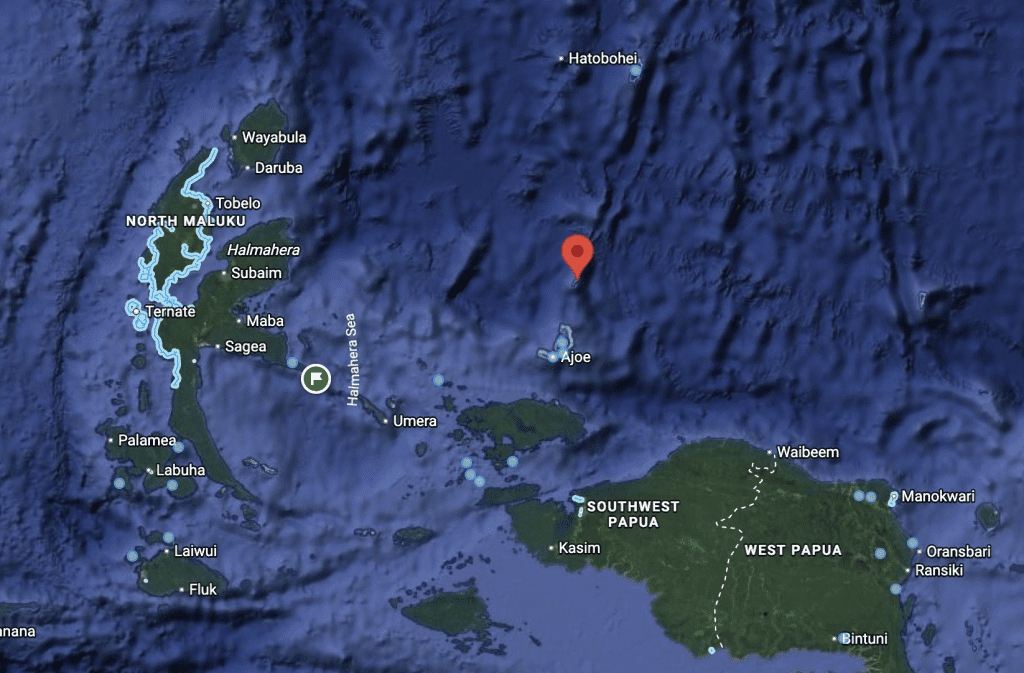
There were roughly twenty Indonesian Navy soldiers on Fani Island when we arrived. They had a pet coconut crab. They were surprised to see us – which, honestly, I get. We anchored, introduced ourselves, and waited. In about eighteen hours, the Moon was going to slide directly between the Earth and the Sun, and this tiny outpost – this forgotten comma at the very northern tip of Indonesia’s Bird’s Head – was sitting almost perfectly on the centerline.
We hadn’t ended up there by accident.
The Route That Earned It
The trip started, as many of our expeditions do, in Raja Ampat – which sounds like an easy beginning until you remember that Raja Ampat is already one of the most biodiverse marine environments on the planet. We spent the first days properly in it: trekking for birds of paradise in the Dampier Strait, diving with mantas, watching local kids from Arborek village present those same mantas to our guests with a pride that’s genuinely infectious. A beach BBQ somewhere north of the equator. The famous viewpoint hike over Wayag’s stacked limestone lagoons, which still stops people mid-sentence no matter how many times they’ve seen photographs.
But Raja Ampat, for this trip, was the warm-up.
From Wayag we turned north into Ayu Atoll – and here’s where the itinerary started to feel different. Ayu sits well off any standard liveaboard route. No dive operators based there, no established sites on the maps most people use, and no particular reason to go unless you’re deliberately pushing the edge of what’s been explored. What I find particularly interesting about places like Ayu is that you can’t really asses them from a distance – you just have to show up, pay attention, and see what’s there. We logged what we found, filed notes for future expeditions. Ayu paid off. It more than paid off. We’ll be back.
Then thirty nautical miles further north: Fani.
To put Fani in context – this is the final frontier of Indonesian waters. You don’t pass through Fani on the way to somewhere else. There is nowhere else. The naval base exists because Indonesia, sensibly, likes to know what’s happening at its outermost edges. Beyond that, the island’s main residents are the coconut crab and whatever’s living in the reef below. Internet: none. Phone signal: occasional, unreliable, and not really the point. The outside world had genuinely gone quiet, and I’d’ve been lying if I said I didn’t love that.
Weather Is the Variable You Can’t Control
Anyone who’s planned an eclipse expedition knows the particular anxiety of the days before totality. You’ve done everything right – the route, the positioning, the timing – and then a weather system that wasn’t on any forecast decides to park itself overhead. Indonesia makes this worse than most places. The large mountainous islands generate their own cloud. They are, meteorologically speaking, not to be trusted.
The smart move is positioning: stay away from the big islands, away from anything that generates its own weather, give yourself room to move if you need to. On the morning of March 9th, skies in the region were mostly cloudy just after dawn. On another boat in the Goraici Islands – about the same latitude as us, just south of Halmahera – passengers were watching the weather with the same controlled anxiety. By breakfast the skies were 70% clear. By the time first contact arrived at 8:35am, the clouds had backed off enough that the relief was almost physical.
We had clear sky over Fani. The coconut crab was indifferent.
What Totality Actually Looks Like
The thing about an eclipse that no photograph or video quite prepares you for is the approach. Even before the Moon’s shadow arrives, the quality of the light changes. The equatorial sun is merciless – you know its weight on your skin within minutes of standing in it. As the Moon’s disc began to move across it, the temperature dropped in a way that felt dramatic and almost deliberate, a slow dimming that builds well before the sky darkens. On a beach in Triton Bay – further south, on the same eclipse, outside the totality zone – observers described the light as “not quite as usual” even at 90% coverage. A strange halo formed around the sun. The atmosphere felt wrong in a way that was hard to name.
At Fani, we had the full version.
Totality on the centerline ran to just over three minutes. In the Goraici group – which shared our latitude, sitting about twenty miles south of maximum – observers timed 3 minutes and 6 seconds. Six seconds shorter than the centerline. Nobody was complaining.
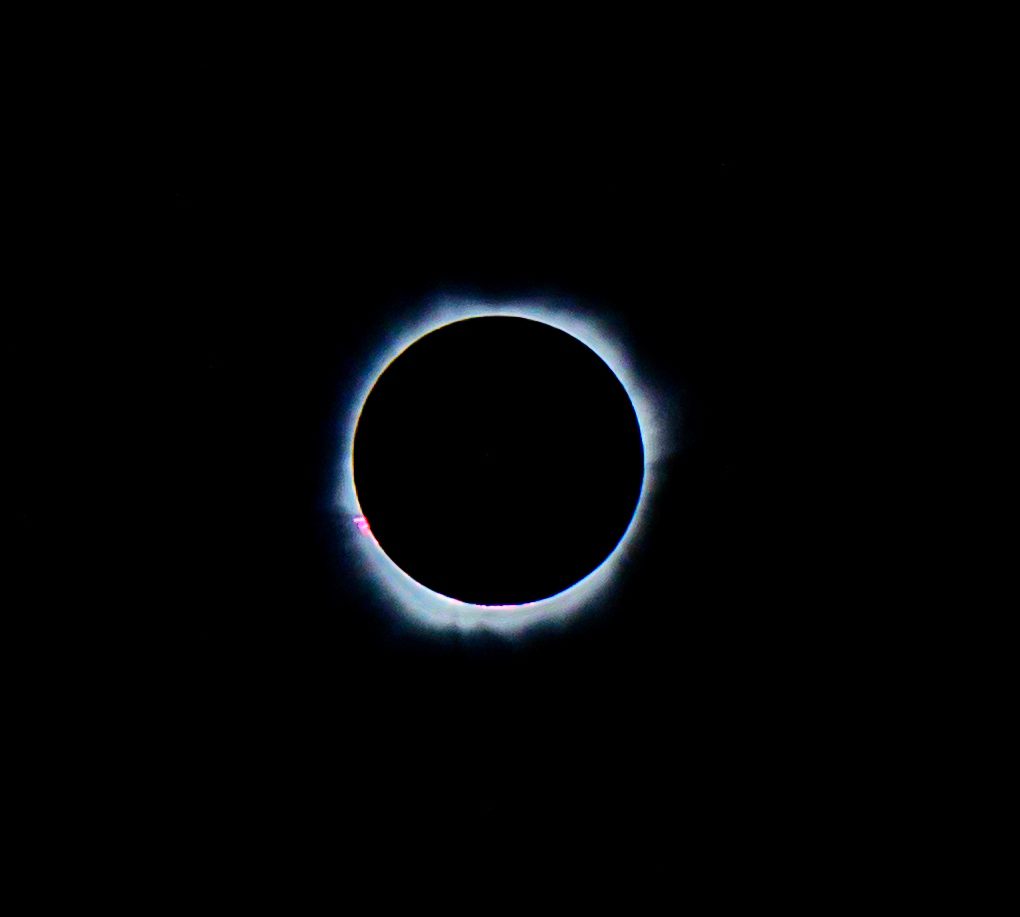
The corona, when it comes, is the thing. Photographs of it are technically impressive and emotionally innadequate. The streamers extend further to the naked eye than any image captures – long structural arms of plasma reaching outward from a black disc that shouldn’t exist. The red chromosphere sits visible at the limb. Solar prominences – the flares that loop off the surface of the sun – are there in real color, naked eye, if you know where to look. The diamond ring at second contact: a single bead of light breaking through a lunar valley at the Moon’s edge, flaring briefly before the corona takes over completely. Then darkness. Stars, potentially, in the middle of the morning.
Three minutes pass. The diamond ring fires again at third contact, from the opposite position. The light floods back. Normal equatorial mid-morning reassembles itself, and you’re left standing in it wondering what just happened.
There is something genuinely difficult to articulate about watching this from a place that almost nobody reaches. The end of the world at the edge of the world? On Fani, it was more so. The soldiers had presumably seen stranger things. The coconut crab had not.
What the Eclispe Expedition Left Us With
We didn’t run a standard tour and happen to be in the right place. We built this route ourselves – the Ayu dive sites, the Fani positioning, the community stops in Raja Ampat that made the early days meaningful rather than just scenic. From my experience in Indonesia, that distinction matters a lot. The difference between being somewhere and actually being present in it is real, and it doesn’t happen by accident.
The expedition taught us things about the northern Bird’s Head waters that you can only learn by going there and paying attention. Ayu is on our list now. Fani is mapped. The passage north from Wayag is one we know.
That’s how Wicked expeditions tend to work. We go somewhere because we think it’s worth going, we operate it ourselves, and we come back with more than photographs.
We haven’t run the eclipse trip again.
Yet.
But this is what we do. Wicked Adventures builds and operates expeditions – diving, kayaking, birdwatching, trekking, climbing – across Indonesia’s eastern islands. We don’t pull itineraries off a shelf. We design routes, negotiate access through the communities we’ve worked with for years, and run everything ourselves with a local team that knows these waters, forests, and mountains the way you know your own neighborhood.
The eclipse trip is a good example of what that looks like at the extreme end. If we can position a liveaboard expedition on a remote naval outpost at the northern tip of Indonesia to hit a three-minute totality window – and pull it off cleanly – then the logistics of your diving trip, your birdwatching week in Papua, or your mixed-activity group program are, frankly, pretty manageable by comparison.
Indonesia is home. We’ve been paying attention for a long time.
Explore what we run at wickedadventures.com – or drop us a line if you’ve got something specific in mind.